The Foundation of Cardiorenal Protection: What the Guidelines Say
In this video series a primary care and cardiology expert panel explore practical strategies for improving cardiorenal risk management in patients with CKD, with and without diabetes.
View the lecture
Prof. Ileana Pina - The Robert Stein Chair of Quality and Safety, Prof of Medicine, Cardiology, Sidney Kimmel COM Thomas Jefferson university, Philadelphia, USA
Through expert presentations, interactive discussion and a real-world patient case, the faculty examine current gaps in cardiovascular risk assessment and CKD management, review the latest recommendations from major international guidelines and discuss how earlier implementation of foundational therapies can improve patient outcomes.
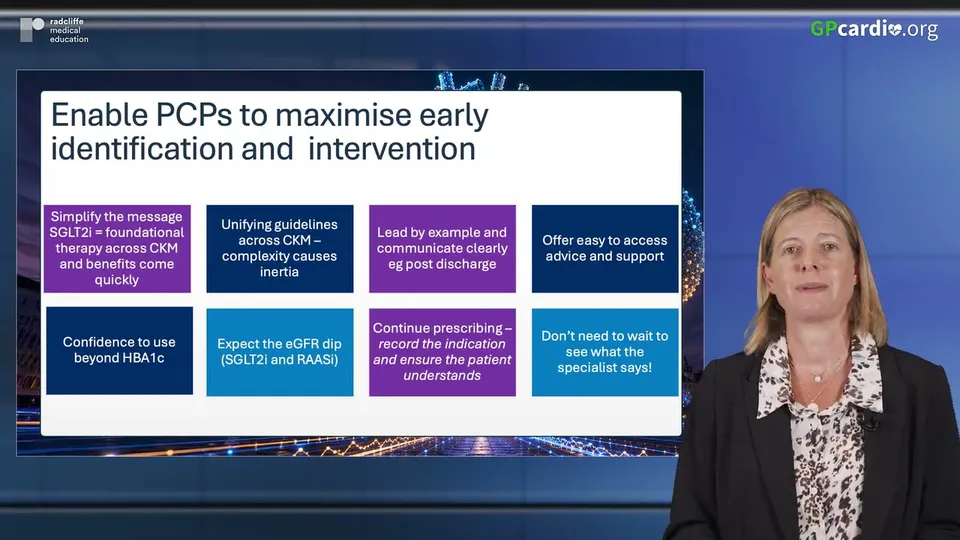
The faculty also explore the role of SGLT2 inhibitors in cardiorenal protection, including when to initiate treatment, how to manage patients throughout their treatment journey and practical approaches to maintaining therapy in everyday clinical practice. Throughout the session, they highlight the importance of collaboration between primary care, cardiology and other specialties to support earlier intervention and optimise long-term patient care.
Disclosure
This programme is supported by an unrestricted educational grant from Boehringer Ingelheim.
CME accreditation
This programme will be available as CME accredited course soon
Radcliffe Cardiology

This education is developed by Radcliffe Cardiology as the exclusive education provider for GPcardio, delivering accredited CME content on its behalf
Transcript
Hello, my name is Ileana Pena. I am the Robert Stein Chair of Safety and Quality at the Division of Cardiology, Thomas Jefferson University, and in Philadelphia, one of our great interests has been reduction of readmission rates. So transitions of care is one of my strong research interests as to how I can get patients through their disease process.
Keep them out of a hospital, but keep them well. So this slide just shows you that we scratched our heads a lot, because 10 years ago, 5 years ago, the patients would come in with all these symptoms, especially somebody that I don't know, and they come in and they tell me, you know, my kidney function, I was told by my primary, is starting to get bad.
Oh, by the way, I'm a diabetic. And so I've got heart failure here, I've got CKD here, and I've got diabetes. Which one do I start with? Because I only got 10 minutes to see those patients, or maybe 15 if I get really lucky. So that's what the head scratching means.
Where do I begin? And as time has gone on, we've realized that they don't occur in isolation; they occur together, and that very often the patients have all of them. Now how diff- difficult can that possibly be? And we also started to learn that there were relationships.
If you altered one, another one got altered. If you started one drug, you needed to stop something else. And it became much more complicated. And we haven't even added the social determinants of health, which is a huge comorbidity that I I see a lot of patients who have a lot of issues.
Related to their healthcare, and so, we also learned that when you added heart failure to this conglomeration, things didn't do so well. The survival rate started to change, and if you really put it together in a slide like this one, where you see that once heart failure is added to CKD and to type 2 diabetes, the event rates go up.
And those event rates become very important because we need to estimate risk. And how are we going to estimate risk if the populations that we're looking at are not like the patients that we have? So we'll come to that. So the whole system has been thinking about how we're going to put this together, and we're calling it the cardiovascular kidney metabolic syndrome.
And I do a lot of work with the American Heart Association. And this has now come out as a guideline, but it's not the only guideline. We have other guidelines, and what it really is saying is that, first of all, this is a holistic approach to the whole issue. We have formal definitions, so there's no questions anymore.
There are definitions that we need to look at and follow. How important are the drugs related to those definitions? And I'm calling it closer to precision medicine. Because now I'm selecting out the patients who have more diabetes or less diabetes, more heart failure or less heart failure, and kind of putting it all together.
So this is a really, really important concept that both cardiologists and the primary cares need to do. They need to do it together. There has to be collaboration. Collaboration is critical to taking care of these patients. And I sit sometimes in the middle of.
People arguing about what they're going to do first. Now these guidelines are going to give us a way to do it. And if you start from the beginning, you really start with a healthy person. What do we call it? We call that prevention. So that the first stage of this isn't even on the stage.
We have four different stages, and every stage adds something. And therefore, every stage you need to do something. You can't just ignore. All these little pearls of wisdom that are coming your way, and it is a critical part. We have added this to our patient education booklet, because we need the patients to understand that all these symptoms of theirs are related, and that we're addressing all of them, maybe in bits and pieces, but we're getting to all of them.
And now that we have stages, we can actually go through. We've done this with all the guidelines. We certainly have done this with the heart failure guidelines through the years. Of where you come in to this picture, where does this patient come into the picture? And we can go stage 0 and 1, which is really the the least cumbersome.
And then when you get to 2 or 4, starts to get a little bit more muddy, because now we have to add, is it hefpef or is it hefref? And some of the guidelines have changed for hefpef and hefref. And the drugs may be quite similar, but it's a different little bit of a different concept that you need to put together.
And we're not the only ones doing this. KDEGO has blessed these guidelines and joined in with us. I've been on several KDEGO boards. They put out a very important guideline in 2022, but then they came up in 2024, really expanded it.
And where the expansion sits is when do you start using the right drugs? I'll have a lot of arguments at work with starting the new drug. There's a lot of concern out there about how difficult these drugs are to start. I don't find that. I find the drugs are easy to start, and when I don't see patients getting hospitalized, I feel better about it.
And we monitor them. Of course, we monitor them. We we get their labs. We have them come in. We call them. So we we do a lot of hands-on, even if we do it at a distance. Similar to that is what we now call the heat map. I've been seeing these heat maps now for years, and the heat maps I find very useful because it's telling me at what point do I really need to intervene.
And I'm hoping that our primary care teams really look at this, tack it out a wall in your office, so that you can look at the individual patient and see where they fit. Obviously, the lower. The number and the right, the worse the disease process. And don't forget, don't forget cholesterol in the middle of all this, because you still have the metabolic part of this definition, which includes cholesterol and LDL, and now the LP little a's, which are coming into really an important point as some trials are starting to get finished.
And the diabetes instruments are now so precise. You're looking at your patient, you're doing a diet, you may be doing metformin. When do you start the SGLT2 inhibitor? I tend to start them pretty early, and some of the patients can actually come off the metformin, and just leave them on the SGLT2 with a lot of education.
All this that I've talked about includes a lot of dedication on educating the patients, getting them to understand as much as their concepts can they can understand. Why are we doing this? What are the numbers that we're looking at? I have some of them that come in and say, "What's that protein for the heart you keep asking me about?
That's that NT ProBMP." And I give them their numbers so they know. I give them their ejection fraction so they know where they're sitting. This is involvement of the patient population. This isn't the physician alone or the nursing alone. And we do it with a lot of collaboration from our teams.
So, in summary, this is new. This is a holistic approach to the issue. This defines risk with our new equations. Our new equations, which are derived from the prevent trial, includes populations that were never included early on in Framingham. For example, more African Americans, more other ethnicity, more women.
For that fact, and so these equations are comparable. To the population that we're trying to treat, it defines the cardiovascular kidney, if you want to call it renal kidney metabolic syndrome, harmonizing now with KDIGO and the American Diabetes Association, emphasizing lifestyle changes.
Patients don't realize how important those lifestyle changes are, and when they do them and they work, they get very proud of themselves because they've actually done something on their own. For their betterment, SGLT2 is a first-line drug treatment in patients with CKD and diabetes.
It's a route to therapy with each comorbidity, which is earlier protection of the kidney. Oftentimes we find the kidney already damaged, and not not in time. The early benefit of the SGLT2 cannot get over emphasized and we have that beautiful heat map.
I thank you for your time.
Summary of lecture
This is a short talk by Dr. Ileana Piña (Thomas Jefferson University, Philadelphia) on managing patients with overlapping heart, kidney and metabolic disease. Her central point is that these conditions should be treated as one connected syndrome rather than one at a time.
The problem
Patients often arrive with heart failure, chronic kidney disease (CKD) and type 2 diabetes together, and clinicians have only 10–15 minutes to decide where to start. These conditions interact: changing treatment for one affects the others. When heart failure is added to CKD and diabetes, event rates rise and survival worsens. Social determinants of health add a further layer of complexity.
The CKM framework
The American Heart Association now defines this cluster as cardiovascular-kidney-metabolic (CKM) syndrome. Its guidance offers:
- A holistic approach with formal definitions
- Staging from 0 (prevention in healthy people) through 4, with specific actions at each stage
- Movement toward more precise, individualized treatment
The higher stages are more complex because treatment depends on whether the patient has heart failure with preserved or reduced ejection fraction (HFpEF vs HFrEF). KDIGO has endorsed this approach and expanded its own guidance in 2024, especially on when to start key drugs. Risk "heat maps" help identify when to intervene.
Treatment points
SGLT2 inhibitors are first-line for patients with CKD and diabetes. She starts them early, and some patients can then come off metformin.
In her experience these drugs are easy to start, as long as patients are monitored with labs, visits and phone calls.
Lipids still matter, including LDL and lipoprotein(a).
Early SGLT2 use protects the kidney, which is often already damaged by the time treatment begins.
Collaboration and patient involvement
Cardiologists and primary care physicians need to work together. Patients should be educated and involved: she shares their NT-proBNP and ejection fraction numbers with them and stresses lifestyle changes, which patients take pride in when they succeed.
Risk estimation
The new PREVENT risk equations are based on more diverse populations than the older Framingham data, with more women, Black patients and other ethnic groups. This makes them better suited to the patients clinicians actually treat.