CKD; New ESC Guidelines: Every Patient with Heart Disease Should Now Be Tested for Kidney Disease
For the first time, the European Society of Cardiology (ESC) has issued dedicated guidelines on managing the overlap between cardiovascular disease (CVD) and chronic kidney disease (CKD). Developed jointly with the European Renal Association, the guidelines were released ahead of ESC Congress 2026 and mark a significant shift in how GPs and cardiologists should approach at-risk patients.
Why this matters for general practice
CKD affects an estimated 100 million people across Europe, and every one of them carries an elevated risk of cardiovascular disease as a consequence of impaired kidney function. The relationship runs both ways: kidney disease accelerates heart disease, and heart disease accelerates kidney decline, often pushing patients toward major cardiovascular events or dialysis far earlier in life than expected.
The encouraging news, according to Task Force Chair Associate Professor Kevin Damman (University Medical Centre Groningen), is that recent treatment advances now allow this combined risk to be substantially reduced with relatively simple interventions.
The core recommendation: test everyone with CVD for CKD
The headline change is straightforward: all patients diagnosed with cardiovascular disease should now be screened for chronic kidney disease, using two simple, widely available tests:
- Blood test – estimated glomerular filtration rate (eGFR), calculated from creatinine
- Urine test – urine albumin-to-creatinine ratio (UACR)
Task Force Chair Professor William Herrington (University of Oxford) noted that many CKD patients are already under cardiology care, so broader use of these tests in cardiology settings is a practical way to catch more at-risk patients early and get them onto the right treatment sooner.
The STAMP on CKD framework
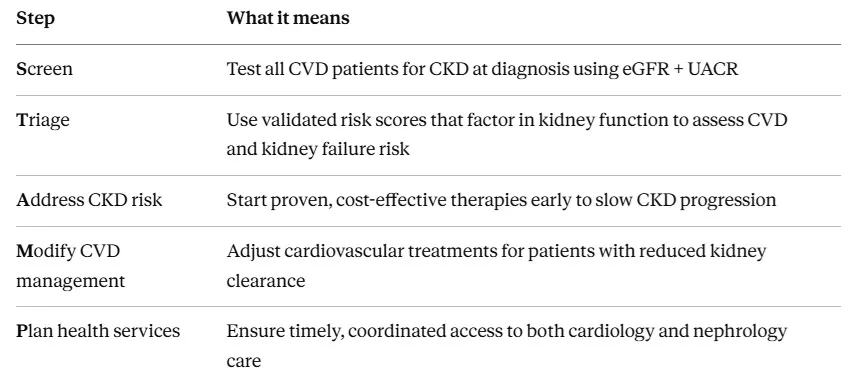
The guidelines introduce a five-step framework to help clinicians structure their approach:
Treatment priorities
Early initiation of the following is highlighted as particularly effective for slowing CKD progression while also cutting cardiovascular risk:
- RAS inhibitors
- SGLT2 inhibitors
- Statin-based therapy
The guidelines also flag specific medication adjustments needed for CVD management in patients with reduced kidney function, since standard dosing may not be appropriate when clearance is impaired.
A team-based approach
Because CVD-CKD overlap is clinically complex, the guidelines stress close collaboration between cardiologists, nephrologists, and primary care — alongside genuine involvement of patients and families in shared decision-making. A patient-facing version of the guidelines has also been published to support this.
Bottom line for GPs
This is a call to lower the threshold for kidney testing in anyone with established or suspected cardiovascular disease. Two simple, low-cost tests — eGFR and UACR — can identify patients who stand to benefit most from early, targeted therapy, potentially preventing years of accelerated decline in both heart and kidney function.