Cardiorenal Risk Management at the Interface of Primary Care and Cardiology
In this video series a primary care and cardiology expert panel explore practical strategies for improving cardiorenal risk management in patients with CKD, with and without diabetes.
View the lecture
Prof. Richard Hobbs, Director, Oxford Institute of Digital Health, Mercian Professor of Primary Care, Oxford Primary Care, Oxford, United Kingdom
President of the EPCCS - European Primary Care Cardiorenalmetabolic Society
Through expert presentations, interactive discussion and a real-world patient case, the faculty examine current gaps in cardiovascular risk assessment and CKD management, review the latest recommendations from major international guidelines and discuss how earlier implementation of foundational therapies can improve patient outcomes.
The faculty also explore the role of SGLT2 inhibitors in cardiorenal protection, including when to initiate treatment, how to manage patients throughout their treatment journey and practical approaches to maintaining therapy in everyday clinical practice. Throughout the session, they highlight the importance of collaboration between primary care, cardiology and other specialties to support earlier intervention and optimise long-term patient care.
Disclosure
This programme is supported by an unrestricted educational grant from Boehringer Ingelheim.
CME accreditation
This programme will be available as CME accredited course soon
Radcliffe Cardiology

This education is developed by Radcliffe Cardiology as the exclusive education provider for GPcardio, delivering accredited CME content on its behalf

Transcript
Hello, I'm Professor Richard Hobbs, Mercy and Professor of Primary Care at the University of Oxford, and I'm going to be talking in a few minutes about cardiorenal risk management at the interface of primary care and cardiology. And I think I'm also going to conclude that that interface between primary and secondary care is a critical one.
Because actually, ultimately, the interface with patients, is going to rely on how effectively, we manage, that relationship. So these are my competing interests. Just by way of background, the risk factors associated with, cardiovascular disease are obviously extremely well known to us, but, additional risk factors have become.
Much more prominent latterly, and most notable amongst those is CKD and diabetes, which are risk enhancers, associated with all major cardiovascular outcomes and indeed has resulted in a redesignation of cardiovascular disease as really cardio-renal metabolic in terms of outcomes and what you can see from these.
Slide is that the impact of CKD and diabetes being felt at whatever stage in that CKM journey, whether it's in patients with risk factors but without extant disease, or whether it's patients with subclinical disease, these risk factors are actually going to modify outcomes.
And obviously, what we're trying to do is to avoid patients suffering events. Which can be obviously catastrophic for individuals and their families, but actually does drive very significant healthcare utilization costs as well. So the topic is a very important one.
Now, one of the big issues in relation to CKD is diagnosis, and what we know is actually there is suboptimal testing for CKD currently, and that's particularly around UACR testing. Where you are looking for protein excretion from the kidney, not just impairment associated with tests such as EGFR.
And repeated surveys have shown that although actually uptake of EGFR testing is good in most health systems, there is a long way to go with UACR testing, and even in high cost systems like the US. Under 40% of patients who have actually got diabetes, and really require guideline mandated testing, only 40% of patients actually get UACR, and around the rest of the world, the rates are potentially even lower, with a very recent systematic review of 30 studies, in 2026 showing that the rates Of testing for UACR in patients with diabetes or hypertension or both, varied from 22 to 49 percent.
It looks as if one of the main issues for practices as to why they aren't utilizing testing is lack of understanding in terms of not realizing that actually under detection of CKD. Could be associated with significant adverse outcomes, and really that's why, this is such an important educational topic, today.
So, in terms of, testing, you're testing, in order to consider, therapies, and one of the biggest, treatment, advances in relation to CKD latterly. Is obviously the utilization of SGLT2 inhibitors, and rather like the data we've just seen in relation to diagnosis, unfortunately there are significant data showing under management of established CKD in many health systems.
These data are from the United States, a big real-world evidence study across 3 million. Patients, and showing even in patients with diabetes, an obvious group of patients where you might consider SGLT2s traditionally, even in that population, who have a grade 1A recommendation for an SGLT2, only around 12% of patients, were being, treated with, an SGLT2, and in patients without diabetes, but a primary indication.
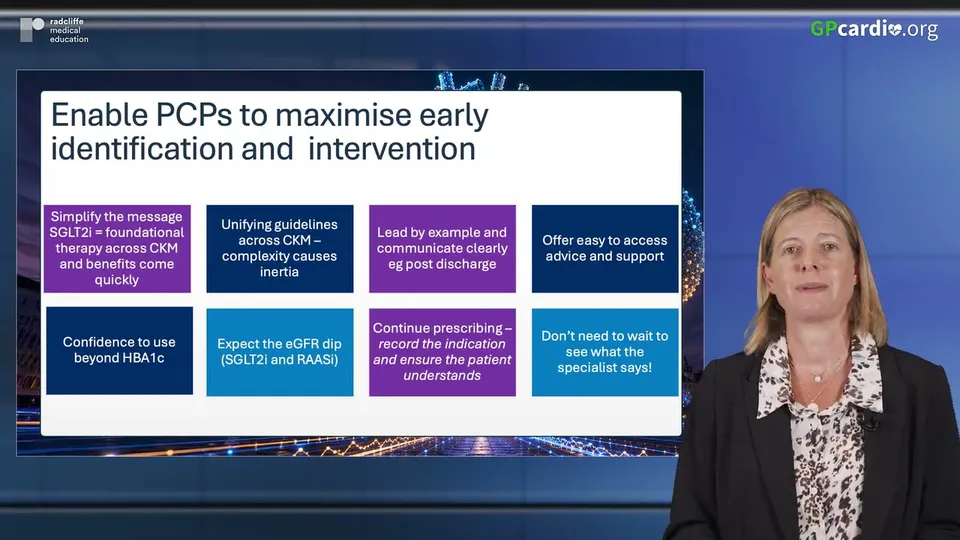
The figure was actually even lower, at around 3%. So, what do the guidelines say? Well, the guidelines recommend that actually there is much better communication, and much better, focus on multidisciplinary management, of patients with CKM syndrome, and that requires us to work out in our own particular health systems how, that interface operates, between.
Primary and secondary care between other specialties that may get involved in patient management, and ultimately how these different teams actually interface with patients. And that I think is a very big issue for us today. And discussing key barriers and solutions to those barriers, I think is an important educational task.
Summary of lecture
Cardiorenal Risk Management at the Interface of Primary Care and Cardiology
Professor Richard Hobbs, Professor of Primary Care, University of Oxford
In this talk, Professor Hobbs looks at how chronic kidney disease (CKD) and diabetes are changing how we think about cardiovascular risk. He argues that the link between primary and secondary care is key to better outcomes for patients.
From cardiovascular to cardio-renal-metabolic
The classic cardiovascular risk factors are well known. CKD and diabetes have now become major risk enhancers, linked to all major cardiovascular outcomes. This has led to cardiovascular disease being redefined as cardio-renal-metabolic (CKM). CKD and diabetes worsen outcomes at every stage of the CKM journey, from patients with risk factors only, to those with subclinical disease, to those with established disease. Preventing events matters for patients and their families, and also because events drive large healthcare costs.
The diagnosis gap: UACR testing
eGFR testing is widely done, but urine albumin-to-creatinine ratio (UACR) testing, which detects protein leaking from the kidney, is not:
- In the US, fewer than 40% of patients with diabetes get the UACR testing that guidelines require.
- A 2026 systematic review of 30 studies found UACR testing rates of 22–49% in patients with diabetes, hypertension or both.
- A major reason seems to be that practices don't realise that missing CKD can lead to serious adverse outcomes.
The treatment gap: SGLT2 inhibitors
SGLT2 inhibitors are one of the biggest recent advances in CKD treatment, but they are badly underused. A US real-world study of about 3 million patients found:
- Only about 12% of patients with CKD and diabetes were on an SGLT2 inhibitor, despite a grade 1A recommendation.
- In patients without diabetes who had a primary indication, the figure was only about 3%.
The way forward: working together
Guidelines call for better communication and multidisciplinary care for patients with CKM syndrome. Each health system needs to work out how primary care, cardiology and other specialties work together, and how these teams engage with patients. Identifying barriers and solutions at this interface is a key educational priority.
Key takeaways
- Test both eGFR and UACR in at-risk patients, especially those with diabetes and/or hypertension.
- Undetected CKD carries real cardiovascular risk.
- Consider SGLT2 inhibitors in eligible patients with CKD, with or without diabetes.
- Strengthen collaboration between primary and secondary care.